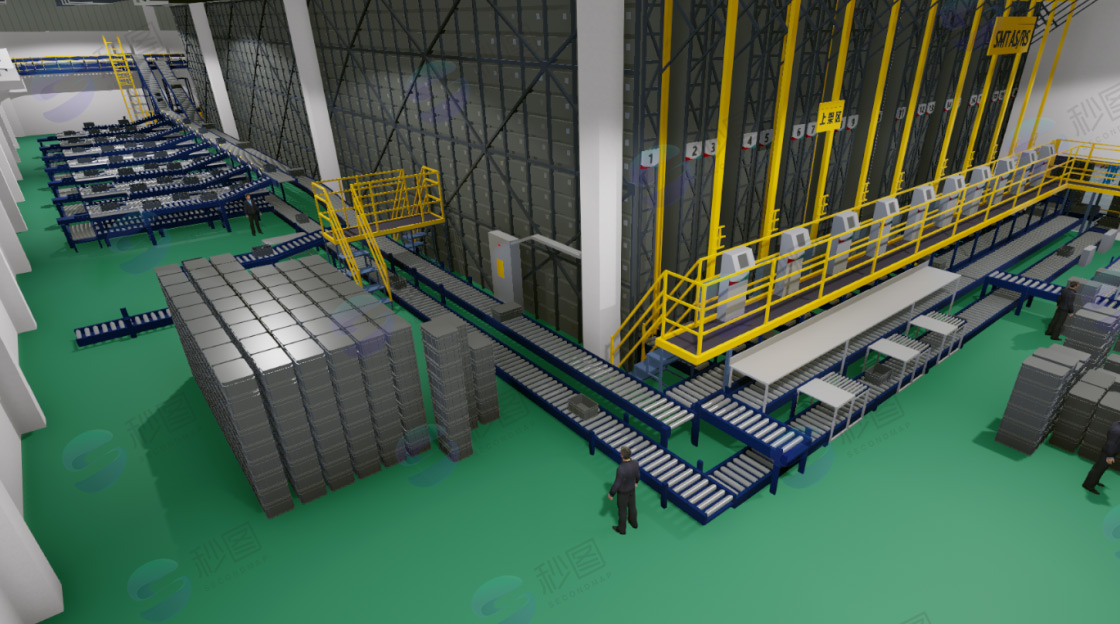
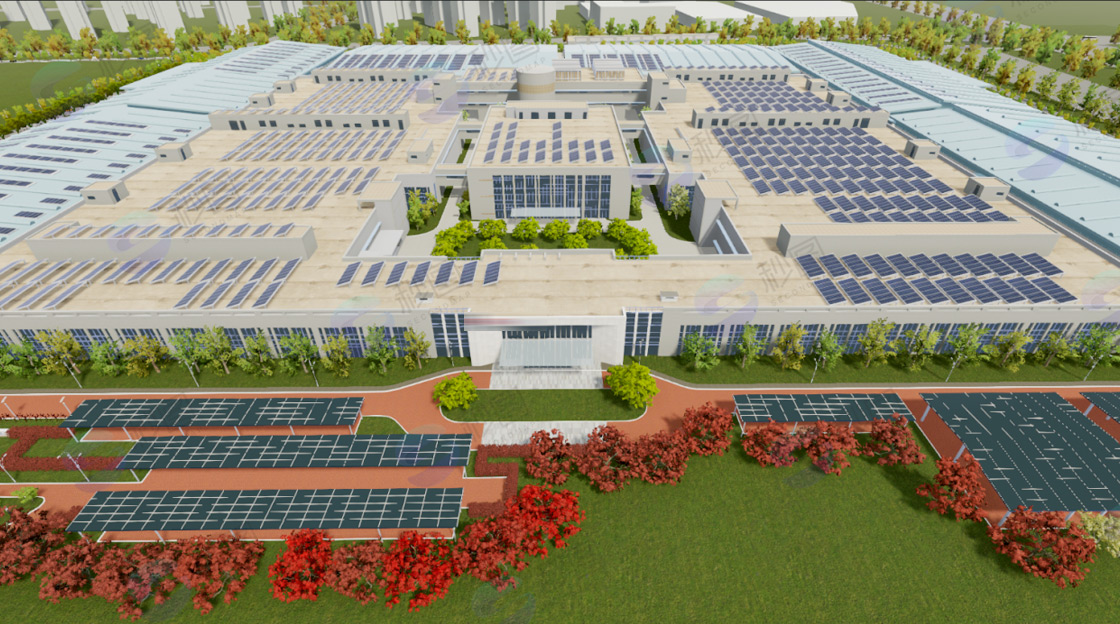
Building a complete digital twin system for logistics and storage, covering all elements from storage facilities to dynamic operations, providing visual support for intelligent storage management, optimized scheduling and efficient operations
Focused on logistics and storage industry characteristics, providing professional, accurate and efficient 3D modeling solutions
Covering storage facilities, equipment, materials, and operational processes to build a complete digital twin storage environment
Supporting dynamic simulation of equipment movement and operational processes, realistically reproducing storage operation status and work processes
Professional optimization for massive shelves and cargo models to ensure smooth interactive experience in large-scale scenarios
Seamless integration with WMS/WCS and other systems to achieve real-time linkage and visualization of business data and 3D scenes

The modeling objects of logistics and storage digital twins need to cover all elements from storage facilities to dynamic operations, aiming to build a highly realistic virtual operating environment
Accurately reproducing the physical structure and spatial layout of warehouses to provide an accurate spatial foundation for subsequent equipment placement and operation simulation.
High-precision modeling of various storage equipment to reproduce their structural features and motion mechanisms, supporting visualization and simulation of equipment operating status.
Accurately dividing and modeling each functional area of storage to reproduce their layout and equipment configuration, supporting visual management of work processes.
Modeling various cargo units and auxiliary carriers to achieve inventory visualization and full-process tracking of material flow.
Modeling various auxiliary facilities and systems to build a complete storage operation environment, supporting comprehensive visual monitoring and management.
Electronic label picking system, LED indicators, etc.
Cameras, sensors, access control systems, etc.
Fire protection equipment, ventilation systems, lighting systems, etc.
Adopting a multi-fusion modeling strategy based on data foundation and application objectives
For new or renovated storage facilities, prioritizing the use of their BIM design models, retaining complete building structure and spatial information through lightweight processing.
Retaining complete building information
Achieving data inheritance from construction to operation
High-precision modeling of core equipment (such as stackers, sorters), customized shelves to accurately reproduce their motion mechanisms and assembly relationships.
Supporting motion simulation and status display
Accurately reproducing equipment details and structure
For existing warehouses, using laser scanning to quickly generate real-scene 3D models for digital archiving and layout optimization analysis.
Authentically reproducing existing warehouse conditions
Quickly obtaining current 3D data
Parameterized batch generation of large quantities of repetitive shelves, conveyor belts, pallet cargo, etc., greatly improving modeling efficiency.
Greatly improving modeling efficiency and standardization
Supporting quick modification and batch updates
Providing multi-level precision modeling services from macro to fine-grained for different application scenarios
Representing the positional relationships of large-scale facilities such as warehouse buildings, roads, and docks for macro logistics planning.
Clearly displaying the division of functional areas, main passages and the overview position of large equipment (such as ASRS) for preliminary process analysis.
Equipment and shelves modeled according to actual dimensions and shapes, clearly distinguishing different types of equipment, and possessing basic attributes. This is the core precision for meeting most storage monitoring applications.
Models include movable components of equipment (such as stacker cranes lifting, AGV lifting) and cargo units, supporting precise data binding and motion simulation.
Achieving extremely high geometric and logical precision, which can be used in logistics simulation software for congestion analysis, capacity assessment and layout plan verification.
To ensure the practicality and efficiency of the system, models must meet the following core requirements
Model dimensions and layout must strictly match the physical warehouse, and the operating logic between equipment (such as AGV paths, conveyor connections) must be accurately reproduced to ensure the authenticity of the digital twin.
Storage scenarios contain massive shelf and cargo models, which must undergo strict model decimation, LOD (Level of Detail) processing and instancing optimization to ensure smooth interaction on the web end.
Models must be organized according to the logical tree of "warehouse-functional area-equipment-component", and each storage location and equipment must be assigned a unique ID and attributes to achieve precise association with business data.
Pre-defining animations for moving equipment and ensuring that model states (such as storage location occupancy, equipment failure) can be driven by real-time data changes to authentically reflect storage operation status.
In the logistics and storage visualization system, 3D models serve as a unified digital base plate and can be deeply integrated with the following core business subsystems
Real-time mapping of inventory distribution, storage location status, and order execution progress on the model to achieve visual monitoring and scheduling of the entire storage operation process.
Real-time driving of model movements of equipment such as AGV, stackers, and conveyor belts to visually monitor their operating status, task execution and traffic dynamics.
Binding cameras, fire protection equipment, and sensors on the model with real-time data to achieve transparent monitoring of security and equipment health status.
Connecting with logistics simulation software to visualize simulation results (such as congestion points, efficiency reports) in the 3D scene for process optimization.
Clicking on packages or pallets in the model can trace their current location, historical movement path and associated order information to achieve full-process visual traceability.
Whether you need to understand the details of 3D modeling technology or want to get a project quote, our professional team will provide you with one-on-one consultation services.
Room 1-1501, Jinhua Garden, No. 385 Jiaotong Avenue, Danyang Street, Xiaonan District, Xiaogan City, Hubei Province, China
(+86)13004585899
service@secondmap.cn
Scan with WeChat