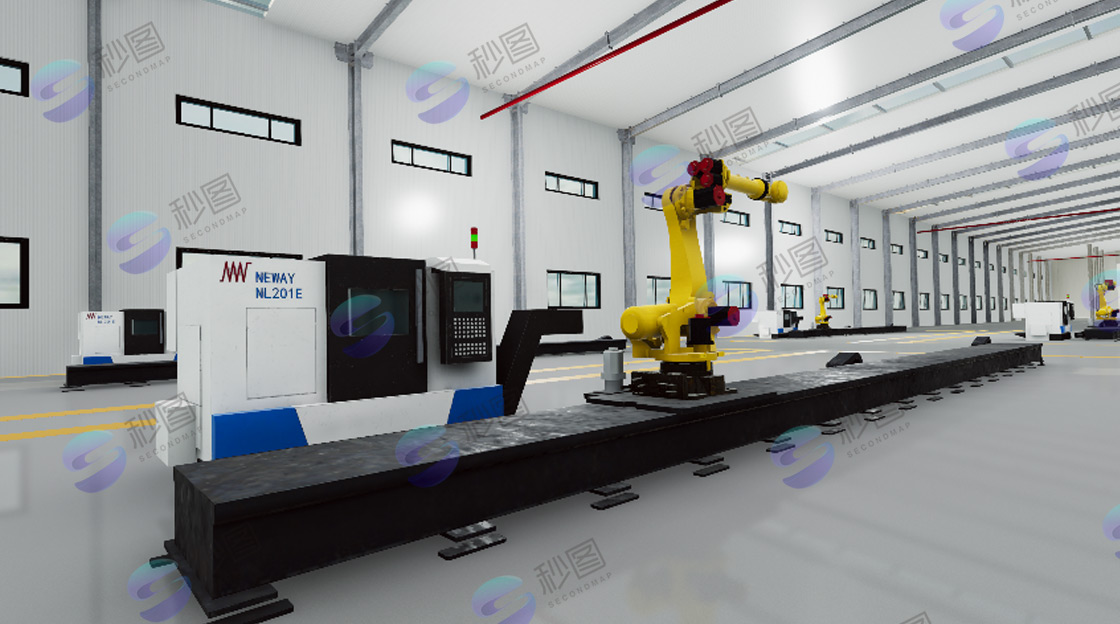
Professional-grade robot 3D modeling services, providing accurate digital twins for visualization monitoring and operation systems, achieving real-time mapping between virtual and physical worlds
Creating high-precision digital twins for robot operation systems, achieving accurate monitoring and efficient management
Geometric accuracy error ≤0.5%, ensuring virtual model and physical device dimensions are completely consistent, providing a reliable foundation for accurate monitoring
Achieving status synchronization through OPC UA protocol with low latency, each component associated with real-time data, realizing accurate mapping of real status
Following ROS system standards, defining physical properties and kinematic parameters through URDF/XACRO files, supporting precise motion simulation
Using LOD technology to optimize meshes, improving Web loading speed, balancing accuracy and performance requirements
Supporting direct loading on mainstream digital twin platforms, providing standardized data interfaces for operation systems, simplifying system integration processes
Supporting status visualization and interactive operations, displaying device health status through color coding, improving operation efficiency

Accurately restoring core functional units, using layered design to ensure system integration and data interaction
The robot's basic support structure, including the main frame, connecting components and protective devices, is the load-bearing foundation of the entire robot, ensuring structural stability and safety.
Main load-bearing frame and support structure
Joint connection base and rotary shaft sleeve
External protective housing and decorative components
Installation interfaces and fixing devices
Temperature monitoring, vibration monitoring, structural stress, installation reference positioning
Core components that implement robot motion functions, using parametric modeling to support motion simulation, accurately restoring motion range, speed and acceleration characteristics.
Robotic arm joints (parametric modeling)
Mobile platform and drive wheel system
Transmission mechanism (gears, belts, lead screws)
End effector and tool interface
Joint angle, speed, torque, motor current, temperature, motion trajectory, fault code
Key components for robots to perceive external environment and their own status, accurately restoring installation positions and sensing ranges, achieving visualization of data collection and environmental perception.
Vision system (cameras, depth cameras)
LiDAR and ultrasonic sensors
Force and tactile sensors
Position and attitude sensors
Perception data, status information, health degree, calibration parameters, data quality metrics
Strict technical standards ensure model quality, meeting all requirements of robot operation systems
Virtual model and physical device size error not exceeding 0.5%, ensuring measurement accuracy
Achieving status synchronization through OPC UA protocol, ensuring real-time requirements
After lightweight processing, ensuring fast loading under standard network environments
Matching degree between virtual motion trajectory and actual motion, ensuring simulation reliability
Ensuring smooth visualization experience, supporting real-time rendering in complex scenes
Strictly following ROS system standards, defining robot physical properties and kinematic parameters through URDF/XACRO files, ensuring seamless integration with ROS ecosystem toolchain, supporting motion planning and simulation.
Achieving data interaction through OPC UA protocol, defining unified data interface specifications, supporting data integration with various monitoring systems, SCADA systems, and MES systems.
Using LOD (Level of Detail) technology to optimize model meshes, automatically adjusting model accuracy according to different scenes, improving system performance while ensuring visual effects, meeting Web and mobile application requirements.
Supporting intuitive display of equipment health status through color coding, animation effects and other methods, including different states such as normal, warning, and fault, facilitating quick identification by operation personnel.
Ensuring models can be directly loaded by mainstream digital twin platforms, including Unity, Cesium, Unreal Engine, ThreeJS, etc., supporting secondary development and feature expansion.
Providing digital support for robot full lifecycle management, improving operation efficiency and system reliability
Achieving visual monitoring of robot operation status through high-fidelity 3D models, intuitively displaying working parameters and health status of each component, promptly identifying abnormal situations and providing early warnings.
Combining real-time data with 3D models to analyze degradation trends of key components, achieving fault prediction and maintenance plan optimization, reducing unplanned downtime.
Providing visual remote guidance based on 3D models, supporting AR overlay display, helping field personnel quickly locate problems and implement repairs, reducing dependence on experts.
Using accurate 3D models and kinematic parameters for path planning and simulation verification, optimizing robot motion trajectories, improving work efficiency and avoiding collisions.
Debugging and optimizing robot programs in virtual environments, verifying the effectiveness of new algorithms and control strategies, reducing dependence on physical equipment and debugging risks.
Building virtual training systems based on high-fidelity 3D models, simulating various operation scenarios and fault conditions, providing safe and efficient training environments for operators.
Whether you need to understand the details of 3D modeling technology or want to get a project quote, our professional team will provide you with one-on-one consultation services.
Room 1-1501, Jinhua Garden, No. 385 Jiaotong Avenue, Danyang Street, Xiaonan District, Xiaogan City, Hubei Province, China
(+86)13004585899
service@secondmap.cn
Scan with WeChat