Industrial Digital Twin Solution

SolidWorks
3D Modeling

Based on SolidWorks professional mechanical design software, building high-precision digital models of industrial equipment, providing accurate "geometric and physical" foundation for manufacturing digital twin applications, empowering digitalization throughout the product lifecycle

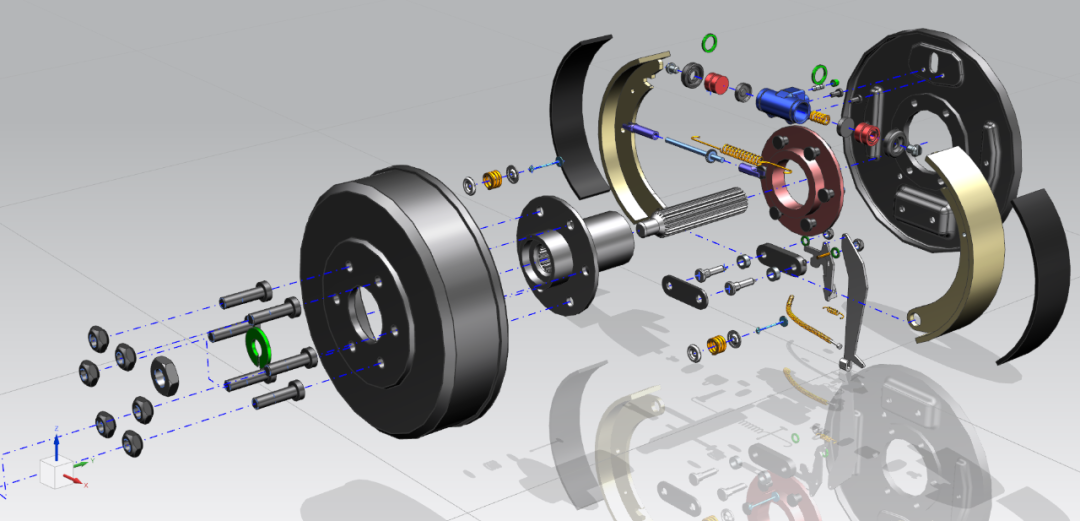
SolidWorks 3D Modeling Effect
Fully Parametric Industrial Model

High-precision digital twin foundation model for mechanical equipment

Industrial Equipment Manufacturing
Automated Production Lines
Robot Systems
Automotive Components
Precision Machinery
Digital Twin Systems

SolidWorks 3D Modeling Main Objects

Focusing on industrial equipment itself and its core components, building high-precision product-level digital models to provide foundation for digital twins

Complete Equipment and Hosts

Complete assemblies of various industrial equipment, including all core functional modules and peripheral structures, achieving precise digitization of overall equipment

  • CNC machine tools and machining centers
  • Industrial robots and collaborative robots
  • Compressors, pumps and valves and other fluid equipment
  • Various automated special equipment

Key Components and Assemblies

Detailed modeling of equipment core functional components, including detailed geometric features and assembly relationships, supporting in-depth functional simulation

  • Transmission systems (gears, lead screws, reducers)
  • Actuators (fixtures, grippers, worktables)
  • Structural frames and protective covers
  • Motors, cylinders and other functional components

Production Lines and Layouts

System-level modeling composed of multiple equipment units, including spatial relationships and logistics paths between equipment

  • Automated production lines and assembly lines
  • Workshop equipment layout and workstation planning
  • Logistics conveying systems and storage layouts
  • Production units and workstation integration

SolidWorks 3D Modeling Core Requirements

To meet digital twin application requirements, ensuring model accuracy, maintainability and scalability

Full Parametric and Associative Design

Models are completely driven by dimensions and geometric relationships, ensuring that any modification automatically updates all associated parts and drawings, guaranteeing model consistency throughout its lifecycle, providing convenience for subsequent design changes and serialized product development.

Accurate Assembly Constraints

In the assembly environment, using mating relationships (such as coincident, concentric, distance, etc.) to precisely define the relative positions and motion relationships between components. This is the foundation for subsequent motion simulation, interference checking and reproducing equipment motion logic in digital twins.

Configuration and Design Table Management

Using configuration functions to manage different versions, states or size series of the same equipment. Through design tables (Excel-driven), parameter variables of serialized equipment can be efficiently controlled and managed, greatly facilitating the adaptation of twin models to different product specifications.

Clear Structure and Semantics

The feature tree (FeatureManager design tree) of the assembly must have clear hierarchy, organized according to the logic of "main assembly-sub assembly-parts-features", with standardized part naming. This lays the foundation for retaining semantic information after model lightweight conversion and associating with manufacturing execution systems/product lifecycle management systems.

Preparation for Lightweight Conversion

Original SolidWorks model files (.sldprt/.sldasm) cannot be directly used for web visualization and must be lightweight converted through professional engines. During the modeling phase, unnecessary details (such as small fillets, complex threads) should be avoided to reduce the pressure of subsequent data processing.

Modeling Standards and Specifications

Following unified modeling standards, including layer management, color specifications, material property definitions, etc., ensuring model consistency and maintainability. Establishing standard part libraries and common component libraries to improve modeling efficiency and quality.

Integrable Subsystem Types

Lightweight 3D models as core data carriers, deeply integrated with various industrial information systems

Product Lifecycle Management

Product Lifecycle Management (PLM)

Achieving deep association of models with bills of materials (BOM), design documents, and change records, ensuring twin models are synchronized with product definitions, supporting full lifecycle data traceability and management.

BOM Association Version Management Change Tracking
Supervisory Control and Data Acquisition/Internet of Things

Supervisory Control and Data Acquisition/Internet of Things (SCADA/IoT)

Binding motion data of model moving parts (such as robot joints) with real-time data, mapping sensor (such as temperature, pressure) data to corresponding positions in the model for transparent monitoring of equipment operating status.

Real-time Data Binding Sensor Visualization Status Monitoring
Manufacturing Execution System

Manufacturing Execution System (MES)

Real-time mapping of production order progress, equipment utilization rates, and capacity data on the model, achieving visual scheduling and management of production processes, improving production efficiency and decision-making speed.

Production Progress Visualization Equipment Utilization Monitoring Capacity Analysis
Computerized Maintenance Management System

Computerized Maintenance Management System (CMMS)

Clicking on specific components in the model can directly associate their maintenance manuals, historical maintenance records and spare parts inventory information, guiding maintenance work and improving overall equipment effectiveness (OEE).

Maintenance Guidance Maintenance Records Spare Parts Management

Service Process

Professional SolidWorks 3D modeling service process, ensuring high-quality delivery

1

Requirement Analysis

Deeply understanding customer requirements, clarifying modeling objects, accuracy requirements, application scenarios and delivery standards

2

Solution Design

Developing detailed modeling solutions, including modeling standards, accuracy control, delivery content and timeline

3

Model Construction

Parametric modeling according to the solution, ensuring model accuracy, clear structure and correct associations

4

Validation and Delivery

Model validation and optimization, lightweight processing, delivery in agreed format and providing technical support

Contact Us

Consult 3D modeling solutions
Get a customized quote

Whether you need to understand the details of 3D modeling technology or want to get a project quote, our professional team will provide you with one-on-one consultation services.

Company Address

Room 1-1501, Jinhua Garden, No. 385 Jiaotong Avenue, Danyang Street, Xiaonan District, Xiaogan City, Hubei Province, China

Contact Phone

(+86)13004585899

Contact Email

service@secondmap.cn

微信二维码

Scan with WeChat

Inquiry form